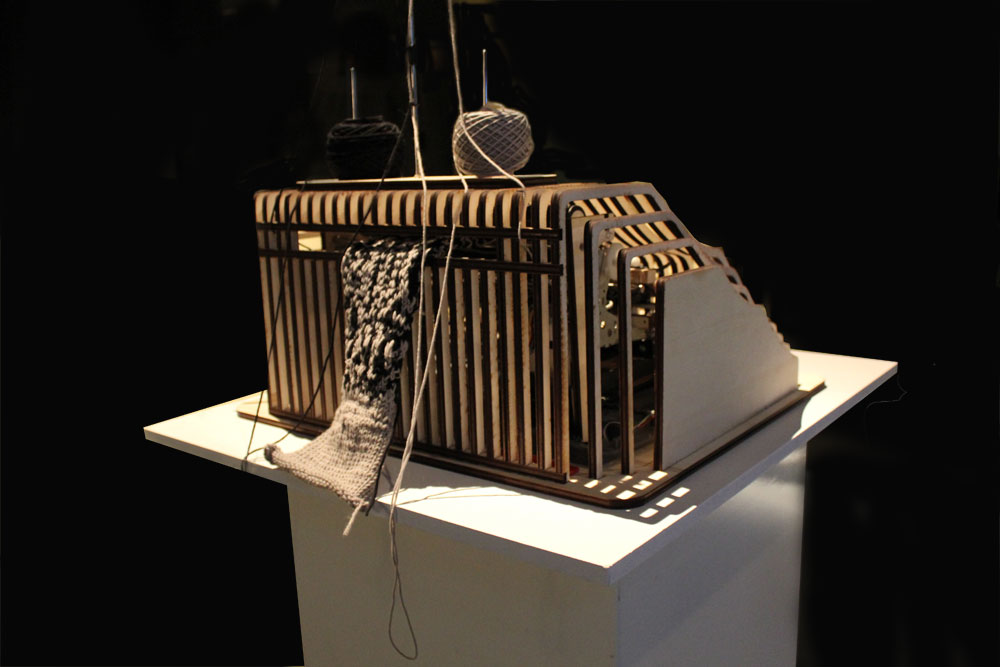
One knitting needle is assigned to each letter of the alphabet.
Interactive knitting machine · 2011
TK 730
An interactive machine that converts typed words into knitted code that can be read, touched and worn.
Read the project ↓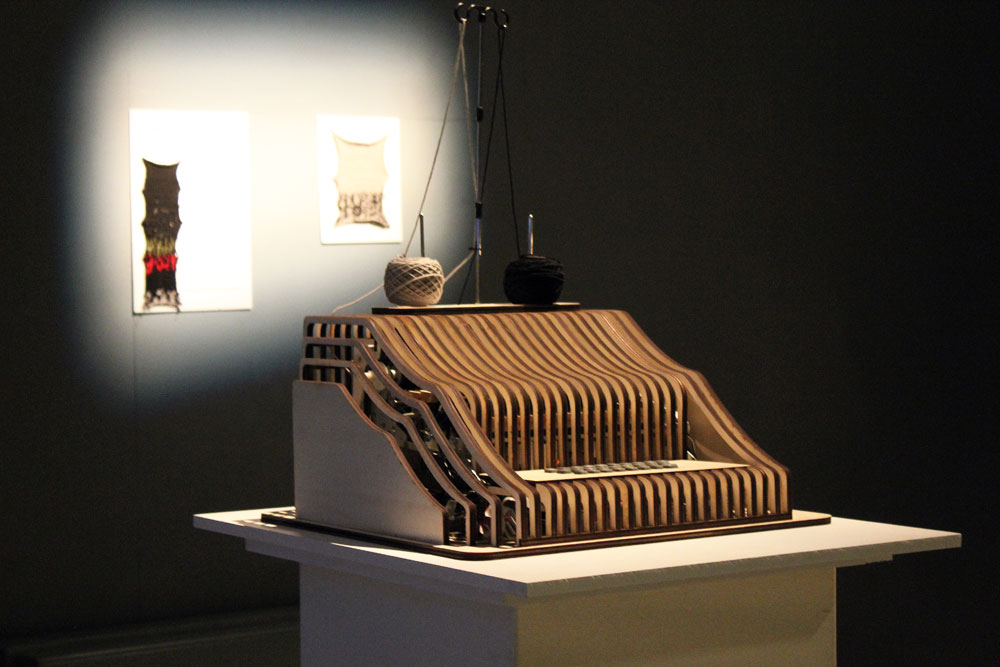
Project typeTool / prototype
ThemesWearables & e-textiles · Materials & making · Speculative & critical design
FormInteractive knitting machine
Developed2011
Input / outputQWERTY keyboard / knitted code
ContextV2_ Summer Sessions, Rotterdam
01 · Proposition
A word becomes a pattern you can read, see, touch and wear
TK 730 turns language into textile: each word entered on its keyboard is encoded as a knitted pattern produced by the machine itself.
The project begins with the shared history of text and textile. Both are connected to the Latin texere—‘to weave’—and TK 730 makes that relation physical by translating a typed word into a material structure.
The machine is both encoder and decoder. It does not knit a conventional alphabet: it rearranges the letters of a word alphabetically, ignores repetitions and maps every remaining letter to one of 26 needles. The result is a unique two-colour code whose meaning can be carried away as textile.
02 · Experience
Type, encode, knit
- 01
Type
The participant enters a word on a familiar QWERTY keyboard. Each pressed key is spoken aloud as immediate feedback.
- 02
Encode
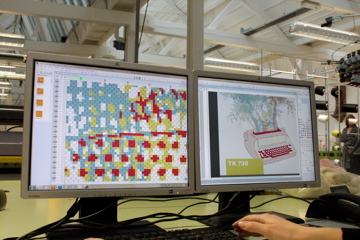
On Return, letters are placed in alphabetical order and repetitions are removed. Each letter is mapped to one of 26 knitting needles.
- 03
Knit
Four motors work in a timed sequence: selected needles knit the highlight yarn while the remaining needles form the ground colour.
03 · Reflection
Digital information acquires material weight
The code is no longer confined to a screen. It becomes a tactile object that retains language while changing how that language can be perceived.
TK 730 crosses writing, computation and craft without presenting one medium as a substitute for another. Reclaimed typewriters, a manual knitting machine and a flatbed scanner were repurposed alongside an Arduino Mega and a custom circuit board. The resulting encounter makes encoding visible as a physical process and invites a word to be understood through pattern, touch and wear.
A carefully timed sequence automates the reclaimed manual knitting mechanism.
The project was published in the proceedings of the Sixth International Conference on Tangible, Embedded and Embodied Interaction.
Credits & archive
Project record
- Concept, design and development
- Meg Grant, Anja Hertenberger, Leonie Urff and Ricardo O’Nascimento
- Residency and production context
- V2_ Institute for the Unstable Media · Summer Sessions 2011 eTextile Workspace
- Acknowledgements
- Piem Wirtz, Simon de Bakker, Stefan Zwegers, Jiskar Schmitz and Christian Waber
References
TK 730 — Proceedings of TEI ’12 ↗