Difficulty is selected through head movement before each performance.
Interactive music game · 2009
Headbang Hero
A music-and-dance videogame in which a wireless motion-sensing wig turns headbanging into choreography, competition and a measure of bodily risk.
Read the project ↓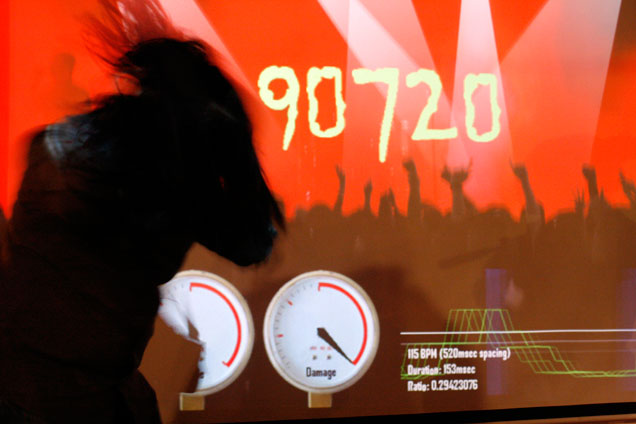
Project typeArtwork · Installation / environment · Tool / prototype · Collaboration
ThemesEmbodied & haptic interaction · Participation & co-design · Speculative & critical design
FormInteractive music game / installation
Developed2009
InterfaceWireless motion-sensing wig
ContextRhythm, performance and health
01 · Proposition
The player’s body becomes the controller—and the health bar
Headbang Hero rewards players for energetic, rhythmic headbanging while simultaneously calculating the physical damage that their performance may cause.
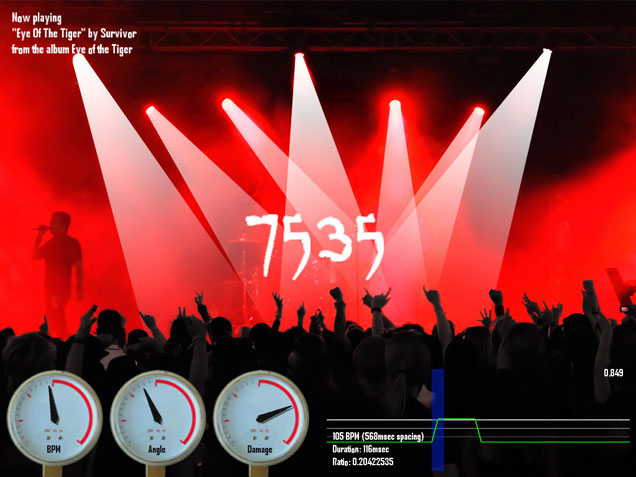
The player wears a long-haired wig fitted with wireless motion sensors. Head tilts select one of three difficulty levels; once the music begins, the system compares the movement of the player’s head with audio peaks detected in real time.
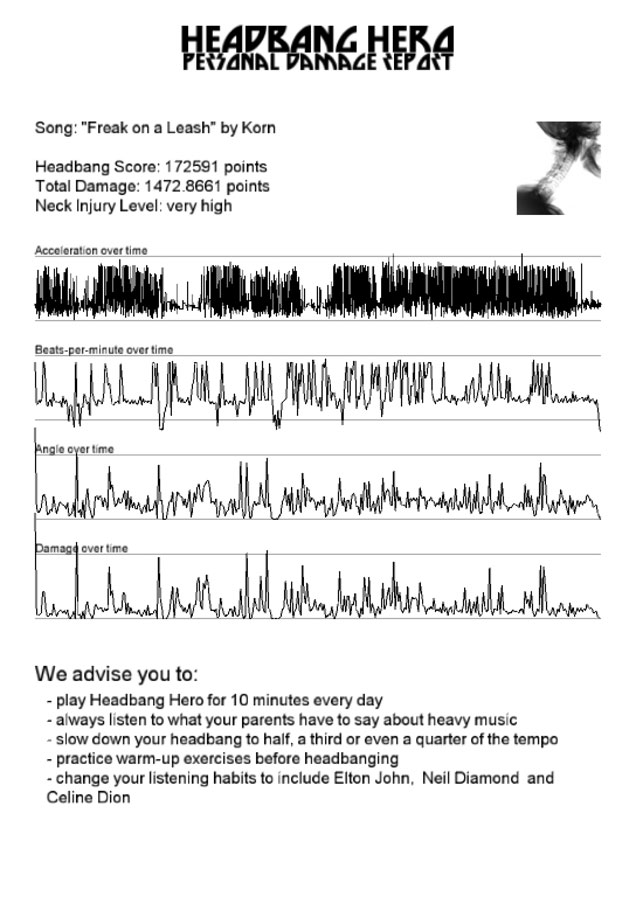
Unlike games in which damage is absorbed by an on-screen avatar, Headbang Hero places the player’s own body at stake. The interface shows rhythm, angle, acceleration and estimated damage while the performance unfolds, joining spectacle and bodily awareness within the same act of play.
02 · Experience
Wear, perform, take the evidence
- 01
Wear
The player secures the wireless motion-sensing wig, which turns head movement into the game’s input.
- 02
Headbang
Movement is compared with the song’s detected beats while the system scores vigor, timing and choreography.
- 03
Report
The final screen and printout record score, acceleration, neck angle, estimated damage and advice.
03 · Reflection
A health game with a heavy-metal sense of humour
The work uses the familiar logic of rhythm games to ask what changes when performance is measured through the vulnerability of the player’s own body.
Headbang Hero is both celebratory and cautionary. The long-haired wig performs metal identity while also operating as a sensor; the score encourages intensity while the damage gauge warns against it. Informed by a 2008 British Medical Journal study on head and neck injury risks in heavy metal, the project satirises music games, motion controllers and health-oriented gaming without removing the pleasure of collective performance.
Motion sensing, beat detection, scoring and estimated damage are calculated live.
Presented in Austria, Slovenia, France, Mexico, Brazil and Japan during 2009–2010.
Credits & archive
Project record
- Concept, design and development
- Tiago Martins, Ricardo O’Nascimento and Andreas Zingerle
- Creative Commons music
- Severed Fifth, Slow Death Factory and Synestesia
- Development context
- Interface Culture, Kunstuniversität Linz