Interactive installation / research instrument · 2024

Enquête d’âme

A tactile installation that lets people articulate wellbeing through sixteen textile-covered keys, building a shared field of colour rather than being measured by an algorithm.

Read the project
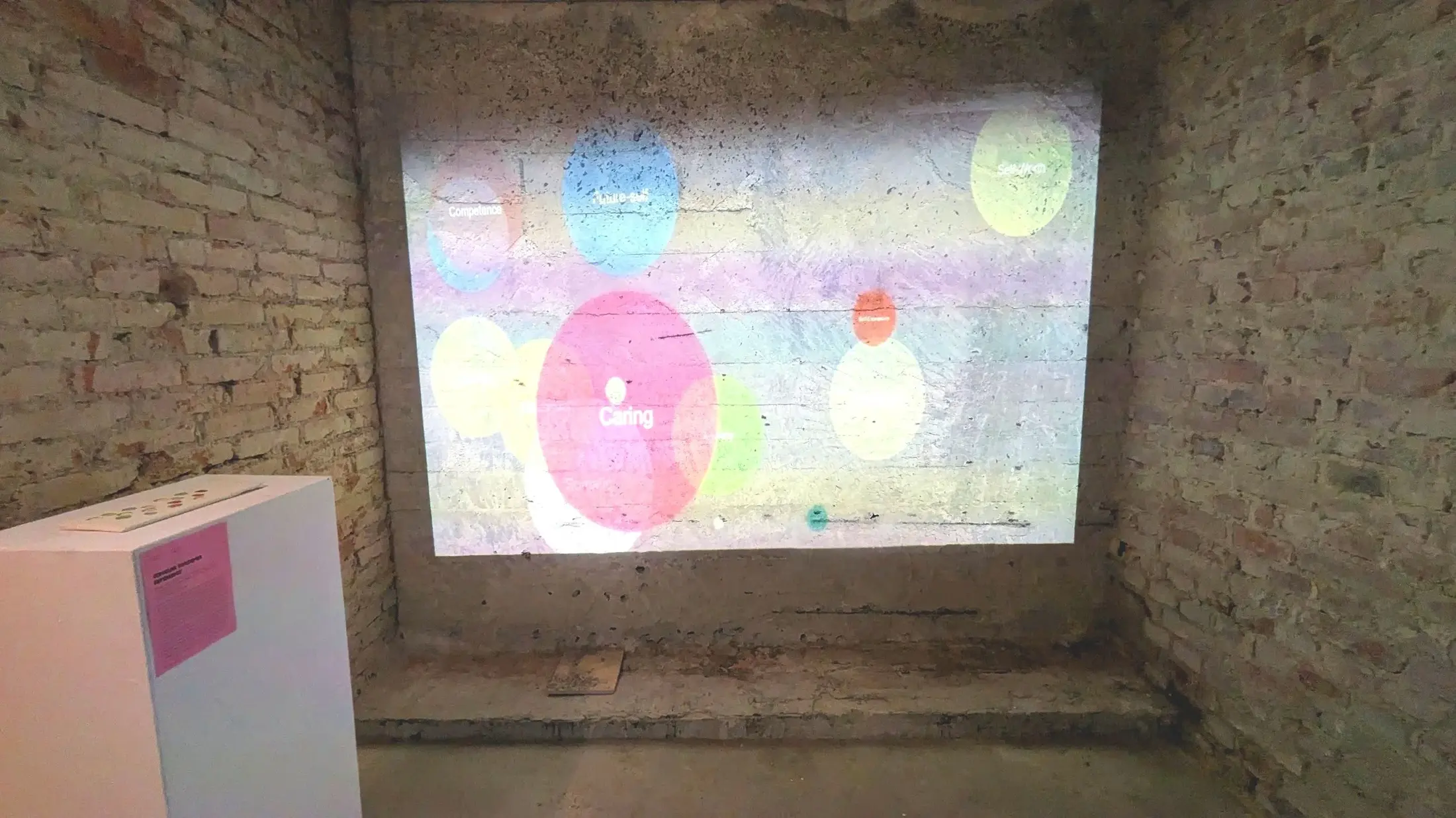
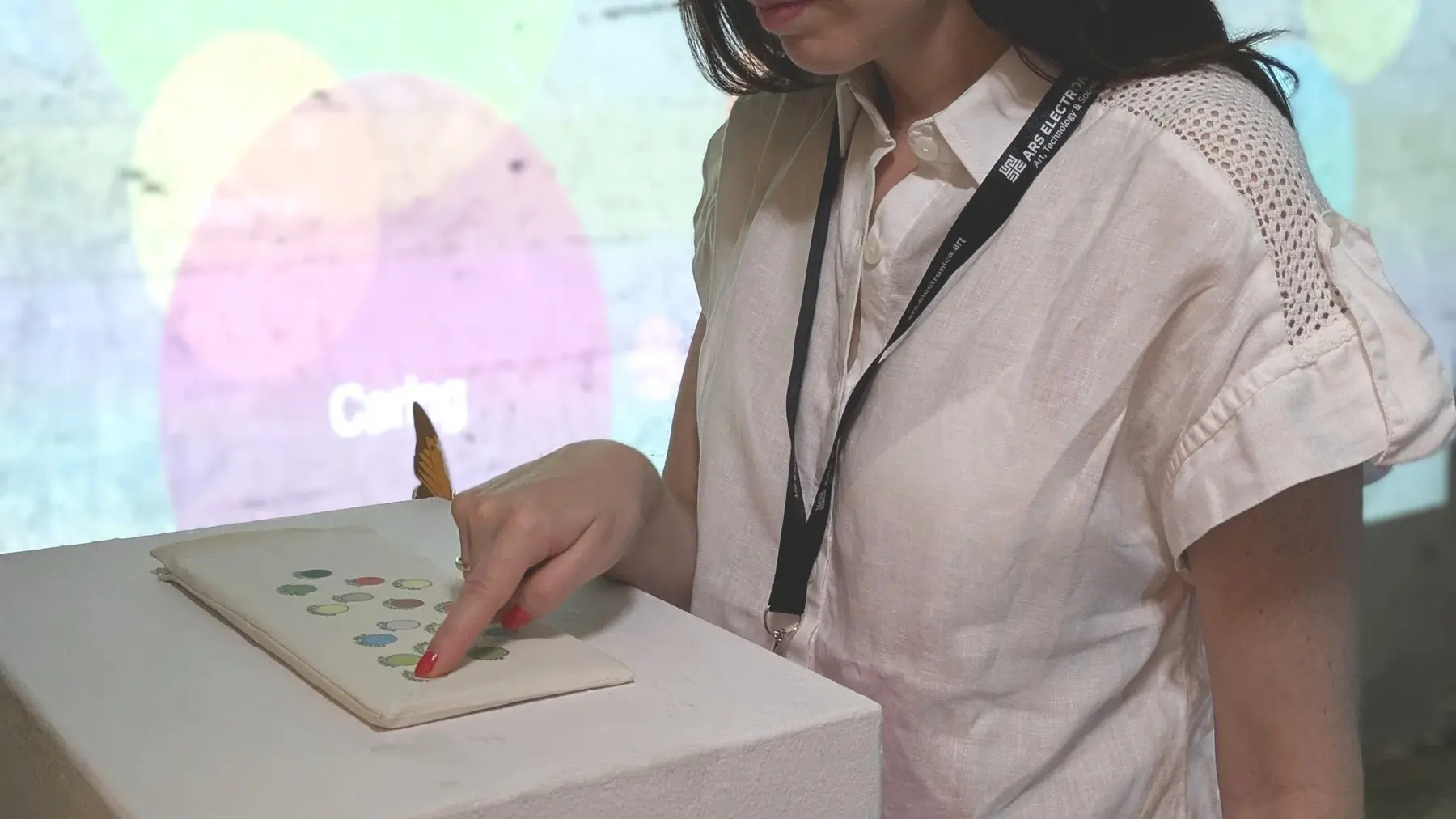
Enquête d’âme installed in a brick-walled exhibition space with a tactile console facing a projection of translucent coloured circles
A tactile console and a shared projection turn individual reflection into a collective visual field.
Project typeInstallation / environment · Research · Tool / prototype
ThemesEmbodied & haptic interaction · Participation & co-design · Speculative & critical design
FormInteractive installation / research instrument
Developed2024
Interaction16 wellbeing dimensions / tactile input
First presentedArs Electronica Festival 2024

01 · Proposition

Wellbeing is articulated, not detected

Enquête d’âme invites participants to identify what wellbeing means in a lived or imagined experience and make that reflection visible within an evolving collective composition.

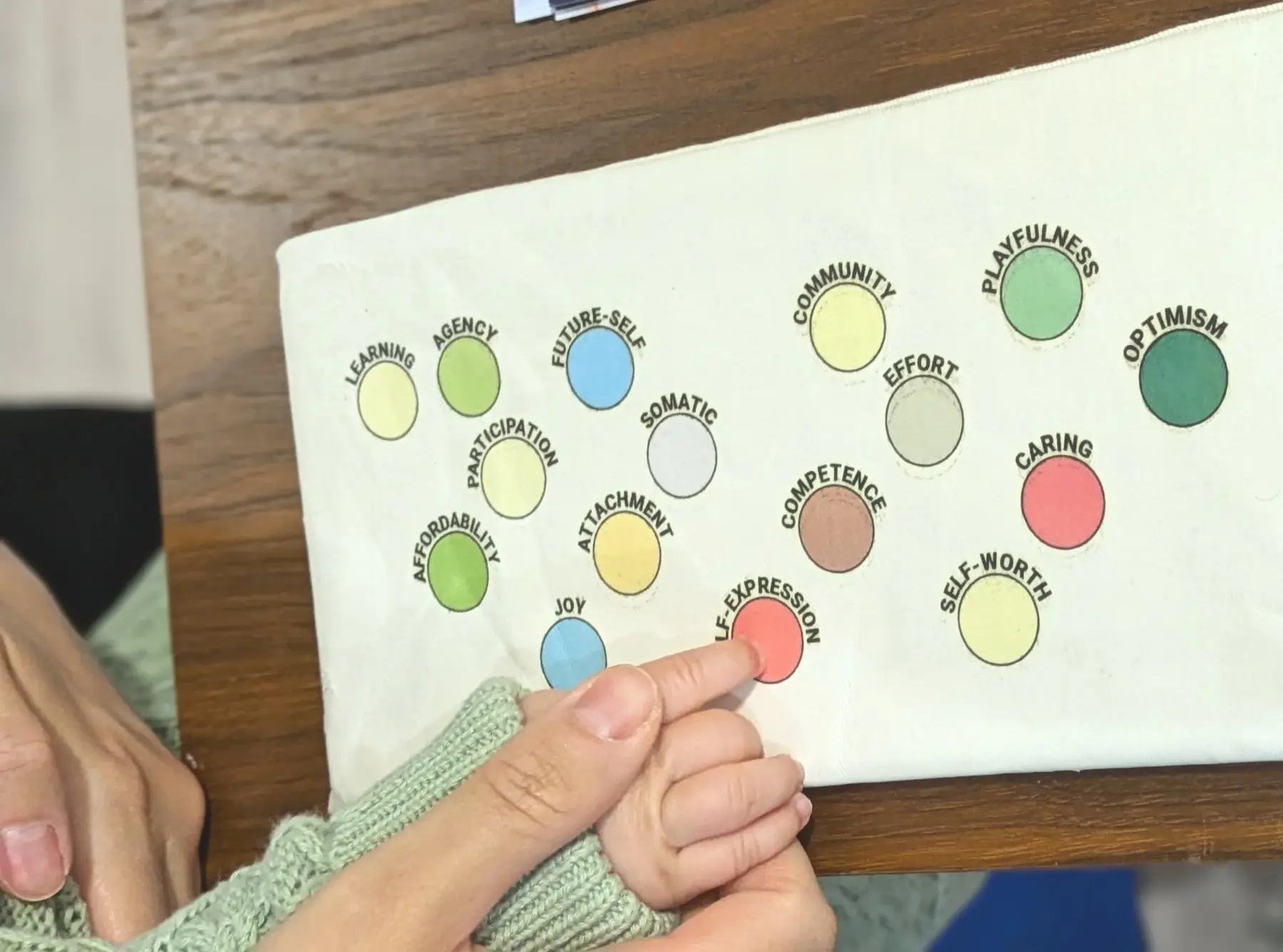
A textile-covered keyboard presents sixteen dimensions from the Wellbeing Framework for Consumer Experiences in the Circular Economy of the Textile Industry, including Attachment, Competence, Playfulness and Future-self. Participants press the dimensions that matter to them; each input generates or enlarges a semi-transparent, colour-coded circle in the shared projection.

The installation deliberately moves away from emotion-recognition systems and passive sensing. It neither infers nor diagnoses feeling. Instead, its slow, one-key-at-a-time interaction asks people to pause, choose and contribute their own interpretation, allowing individual responses to remain distinct while accumulating into a plural wellbeing landscape.

Published research · 2026

Read the paper

Open access · CC BY-NC 4.0

DRS2026: Edinburgh · Design Research Society Biennial Conference · 2026

Enquête d’âme: A participatory visualisation of wellbeing through embodied reflection

Ricardo O’Nascimento and Bruna Petreca

Across three public deployments, the study found that slow, tactile interaction encouraged mindful engagement and helped participants use wellbeing dimensions as reflective anchors rather than diagnostic labels. It presents an embodied method, a mixed-methods research instrument and a visual grammar for plural, collective sense-making.

Presented in Edinburgh, 8–12 June 2026 · Keywords: participatory visualisation, wellbeing, embodied interaction, collective sense-making
02 · Experience

Reflect, select, accumulate

  1. 01

    Reflect

    A participant considers a lived or imagined experience and the qualities of wellbeing present within it.

  2. 02

    Select

    One or more textile-covered keys are pressed to articulate relevant wellbeing dimensions.

  3. 03

    Visualise

    Colour-coded circles appear or grow in the projection, joining earlier contributions without collapsing them into a single score.

03 · Reflection

A collective landscape without a single score

The visualisation holds different experiences together while resisting the promise that wellbeing can be reduced to one reading or diagnosis.

The sixteen dimensions work as reflective anchors rather than fixed labels. Repeated selections make some circles more present, while varied inputs preserve plurality. Across public deployments, the aggregate patterns changed with context: dimensions such as Optimism and Future-self became prominent in policy discussions, while Playfulness and Participation surfaced more strongly in festival settings. The work therefore operates both as an expressive encounter and as a mixed-methods research instrument, coupling subjective self-report with analysable traces.

16 dimensions

A research framework becomes a tactile vocabulary for articulating different qualities of wellbeing.

One key at a time

The deliberately slow interaction supports attention, choice and reflective engagement.

Personal ↔ collective

Every contribution remains visible while becoming part of a shared, evolving composition.

Credits & archive

Project record

Concept, design and development
Ricardo O’Nascimento
Wellbeing framework development
Textiles Circularity Centre — Royal College of Art, University College London, University of Leeds, University of Cambridge and Cranfield University
Academic supervision
Prof. Sharon Baurley and Dr Bruna Petreca
Visual system design
Ricardo O’Nascimento
Funding
EPSRC-funded UKRI Interdisciplinary Circular Economy Centre for Textiles: Circular Bioeconomy for Textile Materials (EP/V011766/1)