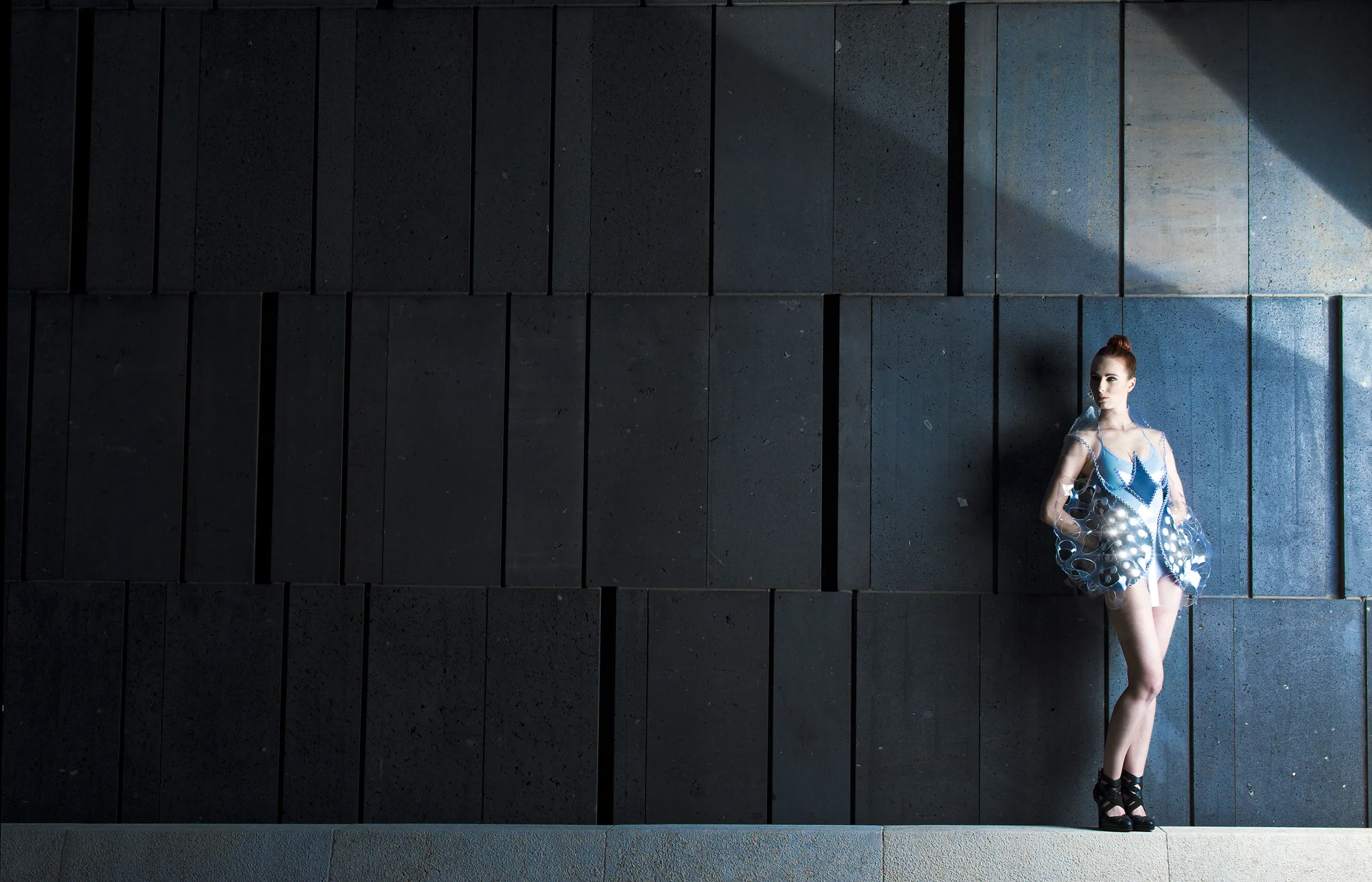
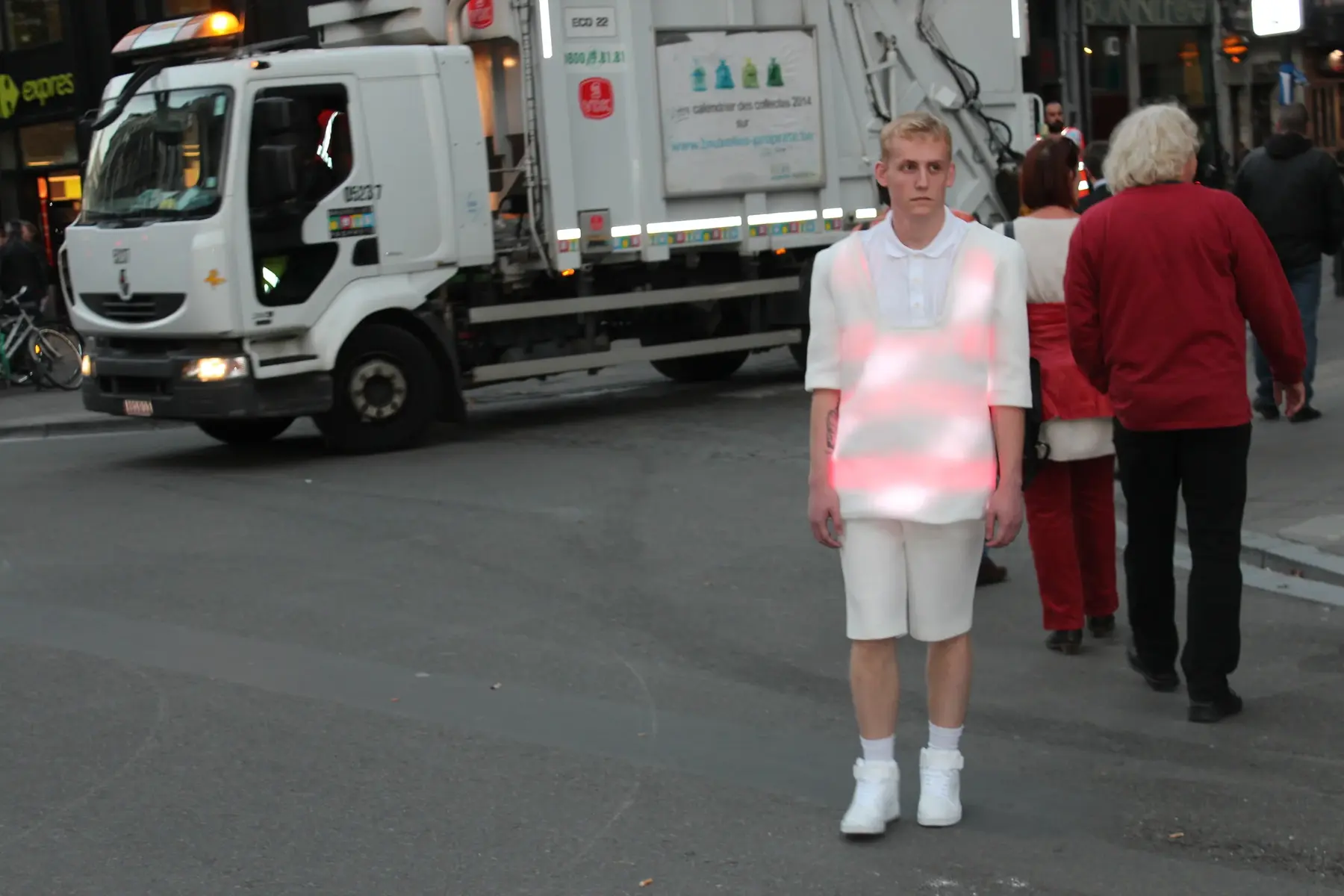
The garment periodically captures new information and refreshes its displayed pattern.
Interactive garment / performance · 2015
Wearable Facade
A luminous garment that samples colours and forms from its surroundings, turning urban architecture into patterns worn on the body and shared with media façades.
Read the project ↓
Project typeArtwork · Installation / environment · Performance · Tool / prototype · Fashiontech
ThemesEmbodied & haptic interaction · Wearables & e-textiles · Speculative & critical design
FormInteractive garment / urban performance
Developed2015
Input / outputMicrocameras / LED patterns
ContextConnecting Cities: In/Visible City
01 · Proposition
The city becomes a pattern worn on the body
Wearable Facade treats architecture as live visual data: the wearer moves through the city, captures the surroundings and carries a changing translation across an illuminated textile surface.
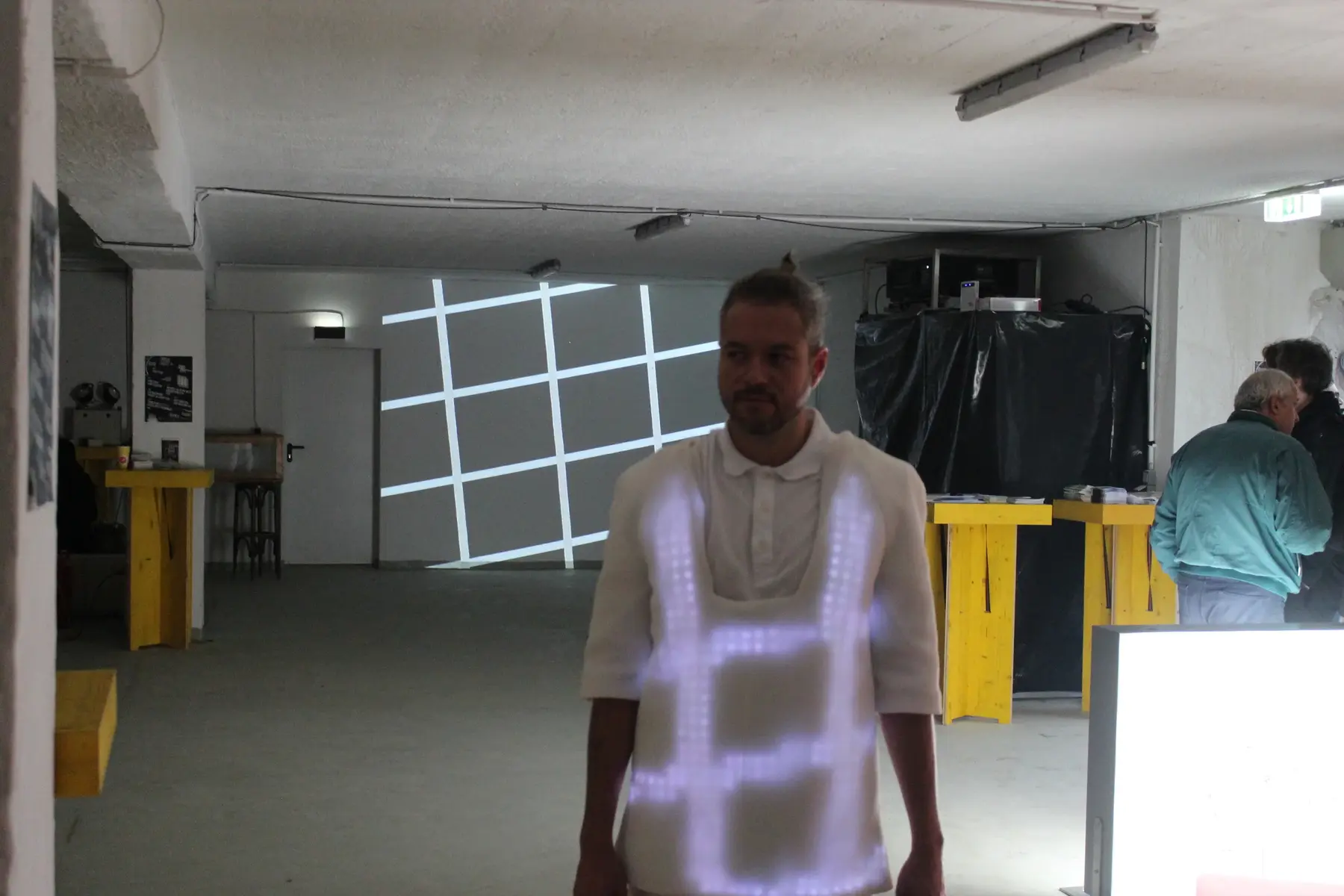
Microcameras embedded in the garment capture colours and shapes around the participant. Software processes this visual information into a generative pattern, which is displayed across the garment’s LED surface and refreshed every ten seconds. The wearer can therefore reflect the immediate architecture or replay patterns recorded elsewhere in the city.
The project begins with the increasingly common media façade—the building transformed into a large public screen—and reverses its scale. Architecture becomes the source of the image, while the garment becomes a smaller, mobile façade. In performances, the same pattern can also be relayed to a building’s media surface, creating a live visual relation between body and city.
02 · Experience
Capture, translate, relay
- 01
Capture
Microcameras gather colours and shapes from the architecture and visual activity around the wearer.
- 02
Compose
Software extracts dominant qualities from the images and transforms them into a generative graphic pattern.
- 03
Display
The LED surface refreshes every ten seconds; during performance, the same pattern can be relayed to a media façade.
03 · Reflection
Architecture becomes a second skin
The garment does not simply display information about the city; it turns the wearer into a moving interface through which the city sees and reformulates itself.
Wearable Facade makes data visualisation both intimate and public. The captured environment is reduced, recomposed and returned as light rather than reproduced as a photographic image. This deliberate translation prevents the garment from becoming camouflage: the wearer remains visibly distinct while entering a feedback relation with surrounding architecture. When the pattern travels to a building façade, the body becomes both source and mobile counterpart of the urban screen.
Visual sensing and a luminous textile surface connect the environment to the body.
A shared graphic links the scale of clothing with the scale of a media façade.
Credits & archive
Project record
- Concept, design and development
- Ricardo O’Nascimento
- Project framework
- Connecting Cities: In/Visible City 2015 / Public Art Lab
- Workshop and urban performance
- iMAL, Brussels · Ricardo O’Nascimento and Erik Overmeire
- Photography
- Mathias Moxter and Frank Vinken