Capacitive embroidery turns the surface of the garment into a playable interface.
Interactive sound dress / performance · 2011
Pinyin
An interactive dress that lets a dancer touch, layer and perform recordings from the musical traditions of Taiwanese Indigenous communities.
Read the project ↓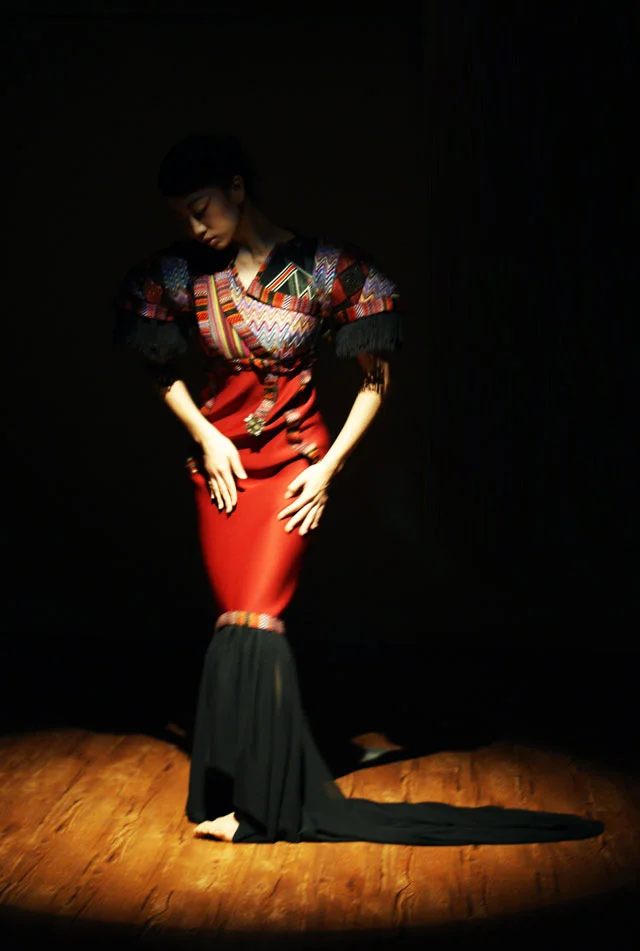
Project typeArtwork · Performance · Fashiontech
ThemesEmbodied & haptic interaction · Wearables & e-textiles · Materials & making
FormInteractive sound dress / performance
Developed2011
Interface7 capacitive textile touch points
ContextTaipei Artist Village residency
01 · Proposition
The garment becomes a body-played archive
Pinyin uses self-touch to connect dance with recordings from seven Taiwanese Indigenous musical traditions.
Seven embroidered capacitive sensors are distributed across the torso within easy reach of the performer’s hands. Touching one point activates a recording associated with a particular community; four speakers embedded in the dress broadcast the response directly from the moving body.
Touching two points simultaneously combines the recordings, allowing separate musical fragments to sound together as an imagined collaboration. The performer does not control the work through an external console: touching, listening and dancing become one continuous bodily action.
02 · Experience
Touch, sound, combine
- 01
Touch
The dancer presses one of seven capacitive embroidered points positioned across the torso.
- 02
Sound
The selected point activates a musical fragment, played through four speakers embedded in the dress.
- 03
Combine
Touching two points together layers recordings from different communities into a new live composition.
03 · Reflection
Listening is choreographed through self-touch
The dress connects musical selection to how the performer reaches across, attends to and moves her own body.
Pinyin treats textile interaction as a performative relationship between sound, touch and gesture. The embroidered sensors remain visually integrated with the garment rather than appearing as separate controls, while their placement produces a vocabulary of reaches, contacts and pauses. At the same time, the work’s mixing mechanism is intentionally speculative: it does not claim to merge distinct cultures into a single tradition, but creates temporary encounters between fragments through the dancer’s choices.
Sound is projected from the dress so the performer becomes both musician and moving source.
Simultaneous contact layers two recordings and expands the dancer’s compositional choices.
Credits & archive
Project record
- Concept and interaction
- Ricardo O’Nascimento
- Collaboration
- Carol Chan
- Residency collaboration
- Taipei Artist Village
- Music research and support
- Taiwan Music Center